

Installation View at Ibn Rushd - Goethe Mosque: Holy Hands, 2021. Artist Silke Lapina
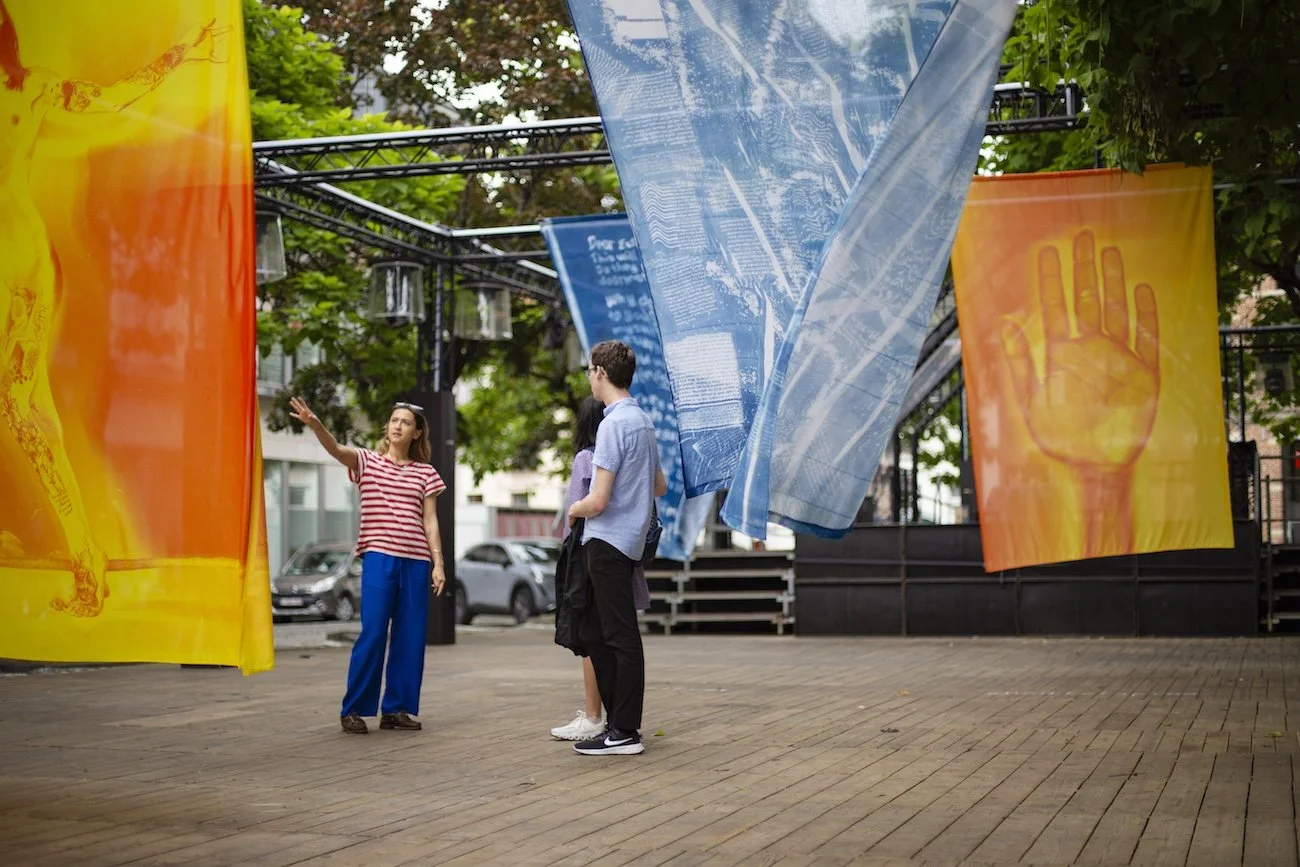
Installation View at Leuven, 2023. Including Holy Hands, 2021. Artist Silke Lapina
Holy Hands, 2021
Digital photographs printed on textile
2 pieces, each 300 × 200 cm
Holy Hands centers on the hand as a universal symbol of connection, touch, and relational presence. Across religious and cultural traditions, the hand mediates between the visible and the spiritual, between proximity and distance. Rather than functioning as an icon, the hands in this work operate as an invitation: to perceive, to feel, and to acknowledge shared vulnerability.
Installed in public and sacred contexts, the work addresses the erosion of embodied connection in contemporary urban life and proposes touch as an ethical and spiritual gesture.
The work draws on Jewish, Christian, and Islamic mysticism, engaging hands as sites of perception and relational knowledge. Printed on textile at architectural scale, the photographic images function as permeable surfaces rather than static images, allowing the work to inhabit both street space and places of worship.
Holy Hands was first presented in the context of a Friday prayer at the Ibn Rushd–Goethe Mosque in Berlin, a space dedicated to interreligious dialogue and openness. Subsequent presentations included installations at the Kirche auf der Bundesgartenschau Mannheim and in Leuven.
"Holy Hands" by Silke Lapina – Text by Paula Dengs 2021
Under the title "Holy Hands", the works of the artist Silke Lapina were presented during the Friday prayer on October 8th, 2021, at the Ibn Rushd-Goethe Mosque in Berlin Moabit. Hands as a symbol of closeness and connection have been at the center of most cultures to this day. Inspired by Jewish, Christian, and Muslim mysticism, the artist Silke Lapina's works mainly revolve around the themes of perception, touch, and connectivity. The symbol of the hand is accessible to everyone and creates a sense of connection. We live in a society that emphasizes boundaries, which are generally accepted and lived by. In a world that seems to have forgotten how to feel, people shake hands professionally and distantly. All too often, this happens in a detached and uninterested manner, with empty eyes and exhaustion. The artist aims to counteract this lack of connection, especially in the isolation of big cities, by using the mosque as an exhibition space.
"I see the Ibn Rushd-Goethe Mosque primarily as a place of encounter and openness. It is a mosque, but the Friday prayer and the subsequent discussion round are accessible to everyone, regardless of whether they are atheist or belong to another religion. A dialogue of different worldviews is not only preached here but also lived. Moreover, something moved me in the mosque for which I have no words - that is what my art is for."
The progressive and liberal Ibn Rushd-Goethe Mosque, which opened in 2017, creates a space for a respectful culture of encounter that aims to bring people together. Co-founder and imam Seyran Ates is a women's rights activist. Unlike the majority of other mosques, women and men pray in joint rows, sermons are also held by women, wearing headscarves is optional, and the LGBTQ+ community is welcome. The theological orientation of the IRG Mosque is based on a humanistic, critically historical interpretation of the Quran, which inspired the artist Silke Lapina in her works. In a societal context where political polarization is increasing, it is necessary to have projects that protect and support spaces of connection and encounter.