
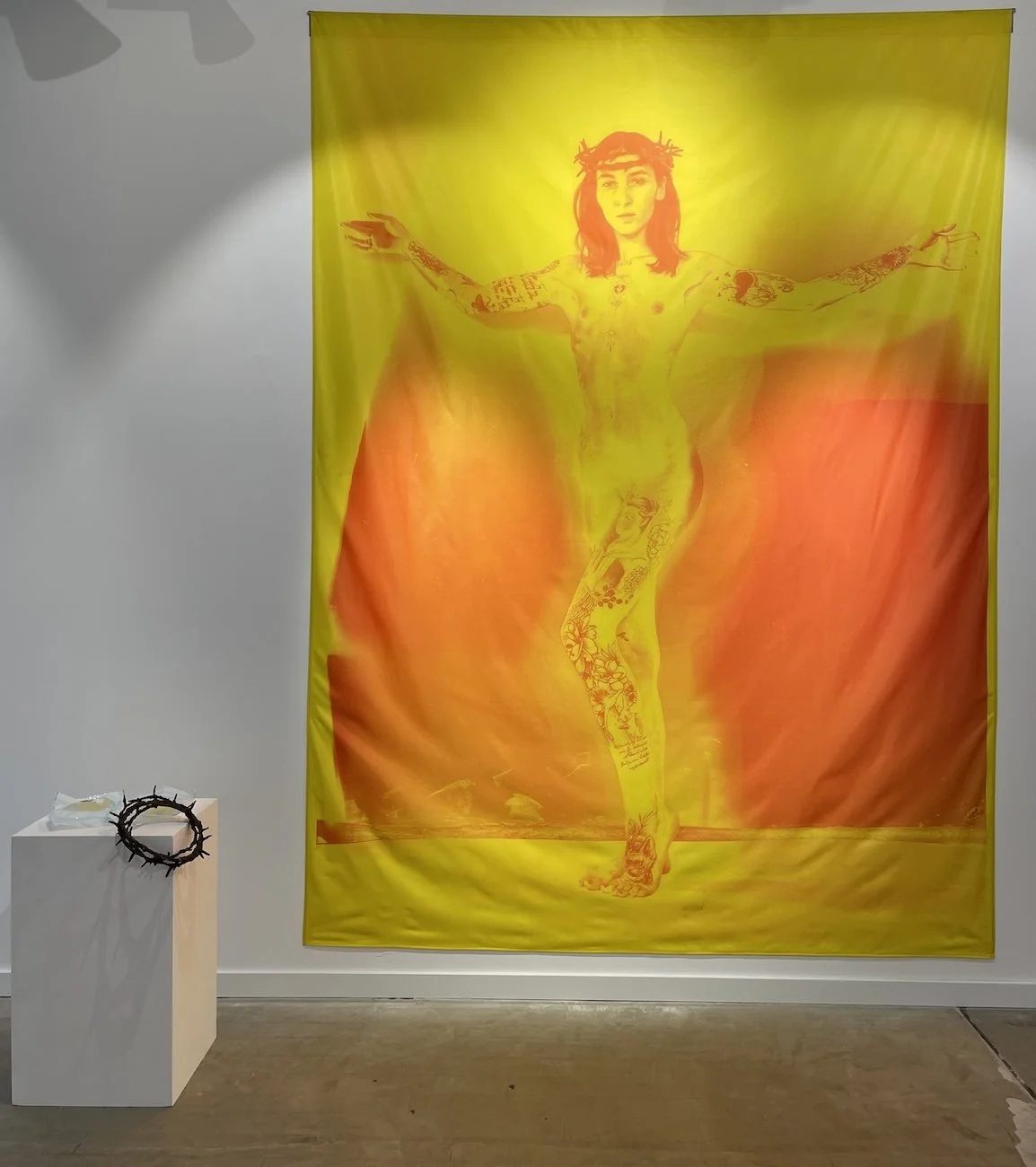
Installation View in Hamburg 2022: JESUS, 2022. Artist Silke Lapina

Installation View in Hamburg 2022: JESUS and Objects, 2022. Artist Silke Lapina

In Texas: JESUS, 2022. Artist Silke Lapina

In Mexico City: JESUS, 2022. Artist Silke Lapina

Installation View in Leuven: JESUS, 2022. Artist Silke Lapina
JESUS, 2022
Digital photography on textile
3 × 2.2 m
Berlin
JESUS is a large-scale digital photograph printed on lightweight textile, conceived to be portable and adaptable to diverse exhibition contexts. The work has been presented in various exhibitions and public settings, emphasizing mobility and accessibility. By using textile rather than rigid display formats, the artist approaches exhibition-making as a flexible practice that allows public space itself to become an exhibition site.
The work is informed by the artist’s early engagement with urban art practices and by exchanges with artist peers such as Ata Bozaci and Nychos, from whom she adopted an understanding of the public realm as a legitimate and necessary exhibition space.
Visually, JESUS reinterprets the figure of Christ through a contemporary, urban lens. The tattooed body of Jesus emerges from a luminous yellow-orange background, printed on semi-transparent textile. While referencing traditional iconography of the crucifixion, the figure is rendered in a way that resists fixed gender and confessional readings. Vulnerability and strength coexist, opening an inclusive space of identification beyond doctrinal boundaries. In this sense, the work situates Jesus not only as a religious figure but as a cultural and existential symbol translated into the present.
"JESUS" by Silke Lapina – Text by Paula Dengs, 2022
Many artists in the past centuries have provided a varied representation of the Christ figure, which were increasingly shaped less by creed than by the existential-human and individual confrontation with the figure. However, to this day, mainly medieval representations shape our image of God, while other forms of images are largely marginalized.
The work "Jesus" by German-Filipino artist Silke Lapina combines pop cultural aesthetics with progressive theology, questioning conventional images of God. The figure of Jesus is not only a religious, but also a profoundly cultural symbol. Lapina's work embodies the confrontation with the image of God in an urban context. With the work, the artist aims to give the representation of Jesus a contemporary framework. It is thematically and aesthetically related to the work "Holy Hands", which was exhibited in 2021 in the liberal Ibn Rushd - Goethe Mosque in Berlin and dealt with the hands as a symbol of approach and connection.
The large-scale textile print portrays Jesus on the cross. The tattooed body rises from the yelloworange tones of the background in the center of the image - almost like a phoenix from the ashes. The color scheme as well as the slightly transparent fabric intensifies the symbolism of the works "Holy Hands" and "Jesus". The posture of the figure implies the cross. The firm, self-confident, yet delicate gaze penetrates and captivates the viewer. Despite the nudity and vulnerability of the portrayed person, the presence of a power that goes beyond the body can be felt. Like Jesus himself, the person carries not only one, but several scars under the chest area. The objects on display in the exhibition are the removed breast implants.
The conventional representations of Jesus on the cross as a male God can impair identification with other genders. The urban-designed figure serves as an identification surface that encompasses everything and brings the figure of Jesus into the present, leaving gender and belief out of consideration. Lapina's representation of the Jesus figure can be interpreted as empowerment that goes beyond the body and its vulnerability. Jesus embodies the wholeness in every person, serving as a model of complete humanity. The gender of the portrayed figure is not clear, thus transforming the representation of the image of God into a new sphere of interpretation.
Despite all criticism of religion, the image of Jesus still exudes fascination for many artists today, as it is a figure that unites the human and the divine and the transcendent power of this figure goes far beyond the religious realm.